

You probably already have an idea of what your business needs before investing in a new design. We come across this situation almost every week. Founders and marketing managers often come to us saying that their business requires a graphic overhaul or a fresh start, but soon face a common question: do we need a logo or a complete brand identity?
The difference is that a logo is just part of your brand identity, while your brand identity is the whole system surrounding your logo. Your decision would depend on what stage your company is at now, how many touchpoints you have, and what the next 18 months will be like for your business.
We have compiled this guide to provide you with insights on what each option offers, where it’s relevant, and how to allocate your budget for logo design and brand identity.
What a Logo Actually Does and What It Doesn’t
It is not necessary for your logo to summarize your whole brand story, your mission statement, and be a tool that helps sell your product. This will most probably not happen in one image.
The core of the logo is very simple. It is a visual identifier that can be either a symbol or a formal wordmark, or both together. It goes on your store window, header of your website, business cards, email signature, and profile photos on social media.
Immediate Recognition
All the tasks of a logo are extremely simple. It just helps people immediately recognize you among others and differentiate yourself from your neighbor. That is all. You might think about your logo as the nametag that you wear at the networking event.
The nametag helps people identify who you are, but it does not provide information about your core values, your work ethic, how friendly you are, or negotiate something for you.
For example, logos for companies like Apple or Nike feature a bitten apple, and there is nothing related to the operating system, customer experience, or aluminum body designs. Similarly, the Nike swoosh is basically a wing shape without mentioning anything about cushioned shoes or athletic performance of shoes. This kind of emotion was created by the company by providing quality customer experiences.
Why Quality Design Is Essential For Creating Impression
Although a logo is simply a name tag, if it is cheaply done, then it becomes a source of friction between you and the customers. It is usually the first visual impression that a new customer gets from your business.
An unprofessional or messy logo will create a question mark subconsciously long before you have gotten through the first sentence of your proposal or before you have mentioned your price range.
A professionally designed logo reflects the quality of your work and creates a positive first impression in the eyes of viewers. Branding is important for the success of any business, regardless of the type of business, whether it is a consultancy firm run by an individual or a sole proprietor, a store in the locality, or a company launching a product idea.
Elements of a Full Brand Identity
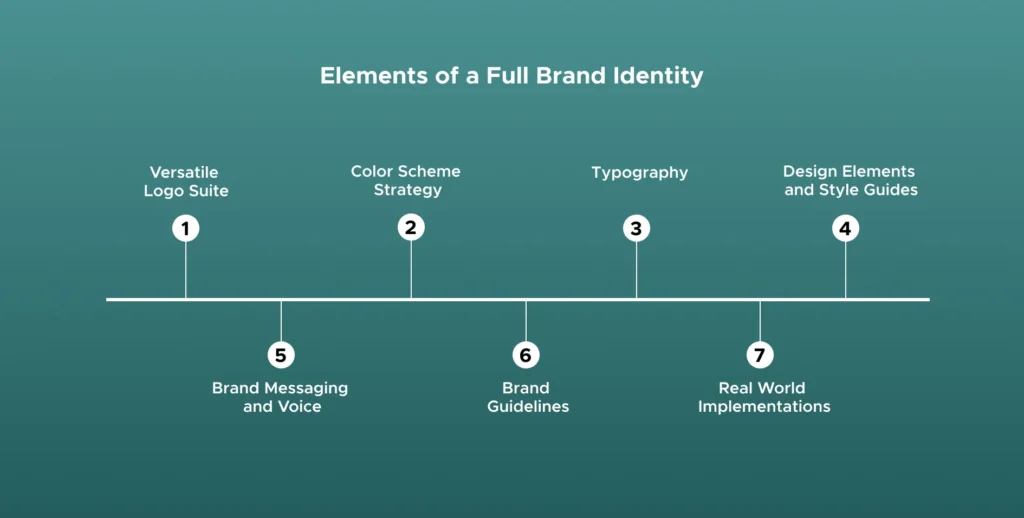
While a logo is your business card, a full brand identity is your persona, your voice, your attire, and body language. This is the whole visual and verbal package designed to create an emotional response each time a customer interacts with your business through any medium.
A full brand identity involves much more than one vector file. Typically, brand identity design services include:
- Versatile Logo Suite: Your main logo design, alternative versions (horizontal, vertical, icon alone), and definitive monochromatic versions to make sure that your logo looks equally good on a giant billboard outdoors as it does on the tiny website icon on your smartphone.
- Color Scheme Strategy: Your main, secondary, and accent colors with corresponding color codes to make sure that your brand colors are consistent across your entire spectrum of media, from high-gloss print to the internet.
- Typography: The selection and combination of fonts for headlines, subheadlines, body copy, and online user interface.
- Design Elements & Style Guides: Design elements like custom iconography, backgrounds, graphic treatment systems, or particular directions for photography.
- Brand Messaging & Voice: Instructions to guide your brand’s voice both on and off-line. Are you funny and relaxed, serious and commanding, or provocative and subversive?
- Brand Guidelines: Comprehensive instructions on exactly how to implement and how not to implement everything.
- Real World Implementations: Pre-designed templates for things like social media graphics, PowerPoint presentations, business cards and letterhead, vehicle wraps, packaging design, or staff clothing.
While a logo can communicate your business, brand identity communicates who you are, what you stand for, and how you speak consistently regardless of the place where you encounter it.
Decoding Branding Jargon: Brand vs. Identity vs. Logo
A lot of the confusion about this matter comes from the language used by design agencies. Marketing executives and creative directors use the phrases brand equity, visual ecosystem, and brand architecture without considering that these terms may confuse business owners.
Here is how the main three terms relate to each other:
- Brand: The entire emotional perception and reputation about your company that people have. You have no direct control over your brand; you only have indirect control by means of customer service, product, and messaging.
- Brand Identity: The toolset you create in order to intentionally shape this perception. It consists of your visuals, voice, and design language. This is entirely under your control.
- Logo: One element of your brand identity toolset.
When a consultant says that your firm needs branding, they might be talking about an out-of-date logo, a message that is confusing, or a customer service experience that is not up to par. If you break down these three layers, you will be able to identify the exact problem and not waste money on improvements that are not necessary.
Decision Matrix: How to Choose the Right Path for Your Business
If you do not want to waste money, be realistic about the current operational situation you are in.
Go With a Logo Design If
- You have to move swiftly: You must hit the market swiftly and validate your business model, while making money instantly.
- You are small and agile: You can be a solo entrepreneur or a micro-team that requires only one or two people to do all your marketing and content writing.
- Your reach is bare minimum: The one main channel you use to reach out to your customers is pretty simple, like a straightforward landing page and one social media website.
- Your spending is highly strategic: You need to retain working capital for purchasing inventory, developing products, or reaching out directly to customers while considering affordable logo design options.
- Consistency is easy to maintain: There is no need for written procedures since you manage everything yourself.
Invest in a Full Brand Identity If
- You are operating in a highly competitive market: You need a distinctive appearance to compete with the existing companies.
- You are expanding: You are either recruiting more employees, employing outsourced firms, or opening retail outlets, where there will be more than one person designing the branding materials.
- You are dealing with multiple touchpoints: Your brand is designed for use in printed matter, physical packaging, corporate presentations, online stores, and advertising campaigns.
- Visual inconsistency is already an issue: You find yourself catching your team using the wrong font, wrong color, or wrong graphic design on a regular basis.
- You are raising money or working with enterprises: You are looking for funding, partnership opportunities, or big contracts.
Need Help Choosing the Right Branding Solution?
Explore Our Branding Services Today.
The True Cost of Making the Wrong Investment
It is quite simple to focus only on the initial cost of the design, but selecting the wrong choice will also have some financial implications later on.
When you need a system, but you purchase merely a simple logo, things get messy very quickly. Your social media coordinator chooses a color for your Canva that seems right to them. Your print shop decides on an appropriate font for your sales brochures. Your website designer uses a minimalist design style, while your packager applies busy graphics to your products.
Within six months, your business can start to look like several different brands using the same logo. Such visual inconsistency decreases consumer trust in you and portrays your company as small and insignificant. The moment you realize that this issue should be addressed, you will necessarily spend money on designing a full brand identity, plus the cost of redoing your marketing materials, websites, and physical objects.
The Middle-Ground Solution: The Mini Identity Kit
Luckily for you, there is often no need to decide whether you want to go with the bare minimum of a logo or with an extensive corporate brand manual. The solution that lies in the middle and fits perfectly for startups and growing companies is called The Mini Identity Kit.
The Mini Identity Kit gives you the essential structure you need without paying for elements you may not actually use, but without the cost of the elements you will not actually use. This package usually includes:
- Primary logo + 2 important variations (horizontal and stacked, for example).
- Simple color palette with 3-4 basic colors and their precise digital and offset values.
- Primary font choice: 1 heading font and 1 body font.
- Short visual guide of 1-2 pages.
This middle-ground solution can be a practical choice for many growing startups in the UAE.
Mapping Your Design Needs Across Each Stage of Growth
Understanding your brand’s growth lifecycle helps put this choice into perspective. A strong brand strategy starts with a few essential steps:
Stage 1. Launch: The mission is validation and speed. What you need is a proper logo, basic color consistency, and a working website to get started.
Stage 2. Establish: Now you have sales consistency, a growing customer base, and maybe even some of your first employees. Visual consistency begins to affect your conversion rates. And this is when having a mini identity system, or at least a baseline brand, comes in handy.
Stage 3. Scale: You have multiple branches, multi-channel marketing campaigns, and even enterprise partners that need your brand guidelines. Having a fully developed brand identity system becomes critical since too many internal and external people are developing brand materials.
Stage 4. Evolve: Markets change, audiences mature, and the service offering grows. And with an identity system fully documented, brand evolution becomes much easier since you know how the whole thing works.
The majority of entrepreneurs who find themselves stuck with the logo vs. brand identity choice are right in between Stage 1 and Stage 2. Identifying this stage helps to make the right decision.
Conclusion
In short, logo vs. brand identity choice will always depend on your current circumstances and future business plans. You should opt for a logo when you need to implement your ideas quickly, wish to test them out, have limited finances, or have a small workforce.
Go with brand identity when you start growing, manage multiple marketing channels, coordinate efforts of multiple content producers, or want to position yourself as an established market leader.
If you are still not sure what to do, consider working with a branding company that can assess your customer touchpoints, growth plans, and current brand needs. That is precisely what we do at Pixako UAE, even before you decide to spend less. We will find what your company needs to grow and help you build it, whether it is a logo mark, a mini-kit, or a full-blown visual ecosystem.
Ready to Build a Strong, Consistent Brand?
Contact Us Today to Build Your Brand
Frequently Asked Questions
What is the difference between a logo and a brand identity?
A logo is a distinctive graphic element that is used to recognize a business entity, while brand identity is the whole range of sensory elements, including colors, typefaces, and tone of voice.
What are the 3Cs of branding?
The 3Cs of branding are Clarity, Consistency, and Constancy. The 3Cs help you convey your message clearly, have consistent visuals across all media channels, and remain visible for the long term.
What are the three main components of brand identity?
There are three key components of brand identity, namely, Visual Elements, Brand Voice & Messaging, and Core Strategy.
How do I create my brand identity?
You can create your own brand identity by following these steps:
- Define your strategy and objective
- Create your voice and message
- Create visual content
- Create your style guide
- Deploy across all platforms