

Not too long ago, CCTV simply implied low-resolution images. But now there are cameras that are linked directly to our phones and alert us to the sight of anyone walking around.
Nowadays, this technology has become cheaper, more advanced, and user-friendly. This shift has an impact on our perception of the technology itself. CCTV is not used only for catching burglars anymore. It has proved to be an effective operational tool in areas that usually do not attract our attention.
We have compiled this guide on uses of CCTV camera systems beyond security, including AI video analytics, and how affordable, intelligent camera technology can be used for operational efficiency and convenience beyond conventional crime prevention.
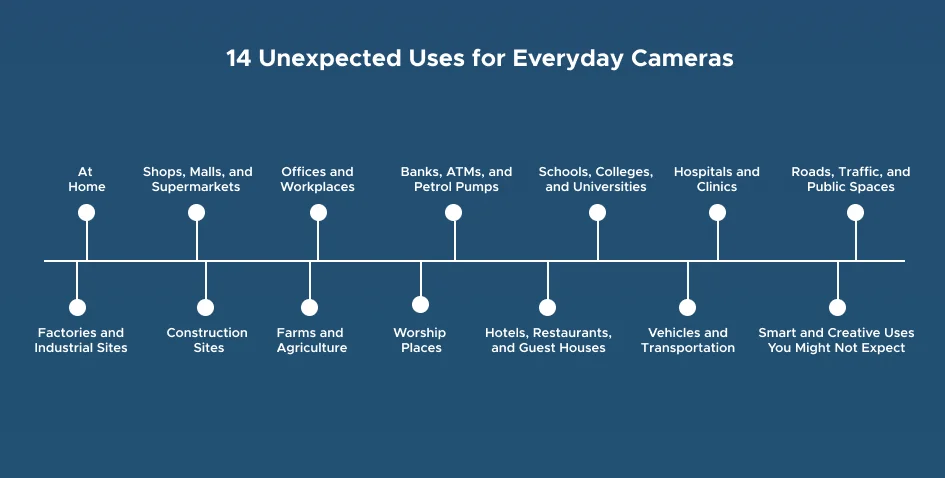
14 Unexpected Uses for Everyday Cameras
1. At Home
Home security CCTV systems are the best 24/7 remote caretaker and smart investment for your family. We usually think about using CCTV for our homes, and rightly so. Having cameras at the front gate, another at the garage, and yet another one in the backyard will work wonders. The mere presence of cameras can deter thieves.
Home security cameras do much more than deter burglaries:
- Taking care of children: When you have your child at home with his nanny or relatives, and you are working, remote video monitoring is very helpful. You will be able to see them when you take a lunch break, and there’s no need to make calls.
- Taking care of elderly parents: There are many people living away from their grandparents. It is a great way to know whether a grandparent has fallen and requires any kind of immediate action.
- Seeing what pets are doing: Do you wonder what your pet cat is up to while you are away? Now you will know with the installation of a CCTV camera. Maybe you will see your dog’s worst activities.
- Monitoring deliveries and visitors: Who is ringing your doorbell, whether you have any deliveries, and all visitors.
2. Shops, Malls, and Supermarkets
CCTV is one of the devices that retailers use to analyze their businesses. Retailers can optimize their stores through CCTV devices. Shopkeepers know that even theft will have a negative impact on their businesses in the long run. There are various advantages of installing 4K security cameras in the retail sector:
- Store security cameras deter shoplifters.
- They act as a go-between when disputes arise between stores and buyers over things like refunds and payments.
- Shops may learn about customers’ movement patterns and better organize their inventory using AI video analytics.
In large shopping centers, CCTV is used to control crowd traffic, find missing children, and handle other emergency situations. Footage from cameras enables security to locate missing children quickly.
3. Offices and Workplaces
Office cameras provide unbiased documentation of access control, property loss, and employee monitoring. In an office setting, CCTV is not meant only for the surveillance of employees. With proper use, it is an effective way to protect both the company and its employees.
Cameras by the entrance document the individuals coming into the property. CCTV cameras near the computer room and finance areas protect expensive equipment. In case there is a loss of property or a dispute between employees, the video will tell the truth rather than letting individuals assume. It is important that employees always know where cameras are located.
4. Banks, ATMs, and Petrol Pumps
Commercial places that deal with a large amount of cash require the use of CCTV cameras to detect any form of card skimming and protect those who work during night shifts. Banks and ATMs deal with large sums of cash; therefore, they become easy targets of criminal activities.
Petrol stations’ CCTV cameras prevent fuel theft, solve payment problems, and keep people safe while working at night.
5. Schools, Colleges, and Universities
The installation of CCTV cameras in schools ensures that visitors are monitored, helps prevent bullying in schools, and ensures the safety of students while using school buses. People send their students to school expecting that they are safe.
CCTV cameras can give parents greater peace of mind. Teachers can observe who is coming and leaving through cameras installed in the cafeteria, playground, hallways, and gates. Regarding bullying cases, the use of camera recordings helps teachers in addressing these issues appropriately.
- Exam halls: For the sake of ensuring fairness while taking examinations, cameras are used to prevent cheating.
- Visitor control: Schools know about the people coming and departing the school.
- Bus Safety: The school buses contain cameras to ensure safety for the kids while traveling back home from school.
6. Hospitals and Clinics
The hospitals monitor their patients through the cameras and secure pharmacies and doctors. These facilities can be quite busy and sometimes tense. The use of CCTV makes them more secure. It can monitor the doors, emergency departments, pharmacies, and parking.
Cameras help nurses monitor falls or wandering of elderly patients within the departments and waiting rooms. Workplace monitoring also protects doctors and nurses from aggressive behavior. The cameras must be installed only in the public areas. They should not be in check-up and change areas.
Need help choosing the right setup?
Contact Our Security and Surveillance Team.
7. Roads, Traffic, and Public Spaces
Cities and traffic control agencies use camera systems to maintain public infrastructure efficiently. The following public places are also beneficiaries of CCTV technology:
- Train and bus stations: Locate lost luggage or people.
- Parks and markets: Ensure that the public is safe in those places.
- Law enforcement: Helps the police in investigating criminal activities through the use of video footage.
8. Factories and Industrial Sites
Industries make use of CCTV systems for implementing safety rules regarding helmets and supervising their automated systems. The industrial setting consists of large machinery, heavy objects, and stringent safety regulations. The application of a CCTV system enables the manager to observe whether staff members are wearing helmets.
Also, the CCTV camera system, beyond security, allows the supervisor to control and observe product quality by monitoring the machinery through a screen. In case the machinery breaks down, the cause is identified through the video.
9. Construction Sites
Building sites utilize camera technology to prevent nighttime theft of equipment and to record time-lapse footage of the construction process. Building sites make for an easy target for thieves since they leave their costly equipment, concrete, and machinery outdoors at night.
There is one more excellent use of camera technology: the camera can be used to capture a construction project’s development process. This time-lapse footage can be shown to potential customers.
10. Farms and Agriculture
Farm cameras help farmers monitor the livestock birth process, monitor crop pest attacks from wild animals, and provide security for different fields. It is not possible for a farmer to be in many places at once, but just a few cameras can do this:
- Animal monitoring: Through cameras installed in animal houses, farmers can watch over their young animals during the night.
- Theft prevention: Protecting equipment and livestock in rural settings.
- Remote Audits from Your Phone: Audit crops, water pumps, and gates remotely from your phone’s display.
11. Worship Places
Worship places in the community utilize CCTV to manage crowds during festivals and to secure gift money. Mosques, temples, churches, and gurdwaras all get contributions and have a lot of visitors throughout the festival season. CCTV serves to preserve these areas of peace and to keep those who come there safe.
12. Hotels, Restaurants, and Guest Houses
The use of CCTV in the hospitality industry serves the purpose of monitoring kitchen hygiene and operations and sorting out disputes among the visitors. The security of the visitors is the prime responsibility in the hotel sector.
13. Vehicles and Transportation
Cameras for vehicles shield the driver from false accident reports and ensure the safety of public transport. In-vehicle cameras installed in cars, trucks, and taxis capture footage on the road while driving. They help the driver in case someone crashes into the driver’s vehicle and tries to make a false claim.
14. Smart and Creative Uses You Might Not Expect
AI-powered CCTV cameras can perform more advanced tasks, and nowadays they can do much more than simply record. Here are some examples:
- Parking: The cameras can read the license plate numbers and open the gate automatically; there is no need for a human to do that task.
- Observing wildlife: The cameras can be used for observing wildlife in the forest without disturbing the ecosystem.
- Flood and Landslide Warnings: The cameras help detect floods and landslides early on.
- Shopping Centers: The cameras will help keep an eye on the number of people coming to the center and the part of the center that gets the most attention.
- Sports matches and Conferences: The cameras help the employees in managing the crowd.
Tips for Choosing the Right CCTV System
Define your needs, select 4K resolution, select either cloud or local storage, and install a backup power supply.
- Be familiar with your environment: The setup for a small store will not be the same as for a large factory.
- Test video resolution: Select a good video resolution so that you can make out faces and license plate numbers.
- Check night vision capabilities: Check if your cameras function efficiently in total darkness.
- Think about storage options: Whether to have a local storage device or cloud storage.
- UPS installation: Ensure that your cameras can work during a power failure.
Conclusion
In short, it is very clear that most of the applications of CCTV cameras are very different now from how they used to be in the past. Now, CCTV cameras provide security for the home environment, security for business places, security for students and patients, help for the agricultural sector, help for the police, and help for the research of the natural environment. The primary function of CCTV is not to capture criminals but to deter criminals.
A CCTV camera system, beyond security, also supports convenience across multiple industries and supports operational efficiency. The process of setting up the correct security camera system is a process that requires technical expertise and coverage planning, among other things. Pixako UAE is a CCTV company in Abu Dhabi. We install different types of CCTV systems along with annual maintenance contracts (AMCs) to ensure you get full coverage of your property.
Need Help Choosing the Right CCTV System?
Contact Our Experts for a Free Consultation
Frequently Asked Questions
What is the primary use of CCTV systems?
The primary use of CCTV systems is to provide safety and accountability, crime deterrence, and real-time monitoring.
What camera is used for traffic monitoring?
PTZ (Pan-Tilt-Zoom) cameras are often used for traffic monitoring. There are several traffic sensor cameras and radar video fusion cameras to improve road safety and support smart city planning.
Can someone watch me through my camera on my phone?
Yes, someone can watch you through your phone camera, but only in a few circumstances, like if you have malicious spyware and have a compromised app with camera permissions.