


Reduce the cost of many thousands of AED by staying clear of the most frequent errors in failed software projects. As organizations grow and expand, the custom software or pre-built software for UAE processes becomes complicated, resulting in a requirement for scalable, custom software. But converting into a custom-built software system brings problems that many business owners are not prepared for.
Many software projects go down after several months of development. This led to missed deadlines, cost excesses, and systems that fail to fulfill the requirements of business. Development is not the issue all by itself. It is usually an unplanned or wrong strategy at the beginning.
We have compiled this guide with the top seven reasons why software projects fail and offer practical software solutions to avoid costly mistakes, and ensure that the software you invest in provides an actual business benefit.
What Does Software Project Failure Actually Mean?
Failure of a software project occurs when a system does not meet the business goals. These include:
- Overrun of budgets.
- Missing deadlines.
- Performance problems.
- Incompatibility and security problems.
- Insufficient user engagement.
Many times the failures are not an isolated event, but rather it is a series of concerns that become more complex over the course due to:
- Lack of planning
- Unclear expectations
- Poor communication
- Insufficient execution of technical requirements.
In addition to the visible problems, the invisible costs of failure can be much greater. This includes:
- Lost productivity
- Interruptions in operations
- Missed revenue opportunities
- Added the expense of system overhaul or redevelopment.
In certain circumstances, it is possible for the software to theoretically work but still be dismissed as unfit because it is not scalable and is integrated with other systems or does not accommodate the changing goals of the business. The result is a disconnect between what was designed as a business and what it really needs to expand.
What a Failed Software Project Really Costs
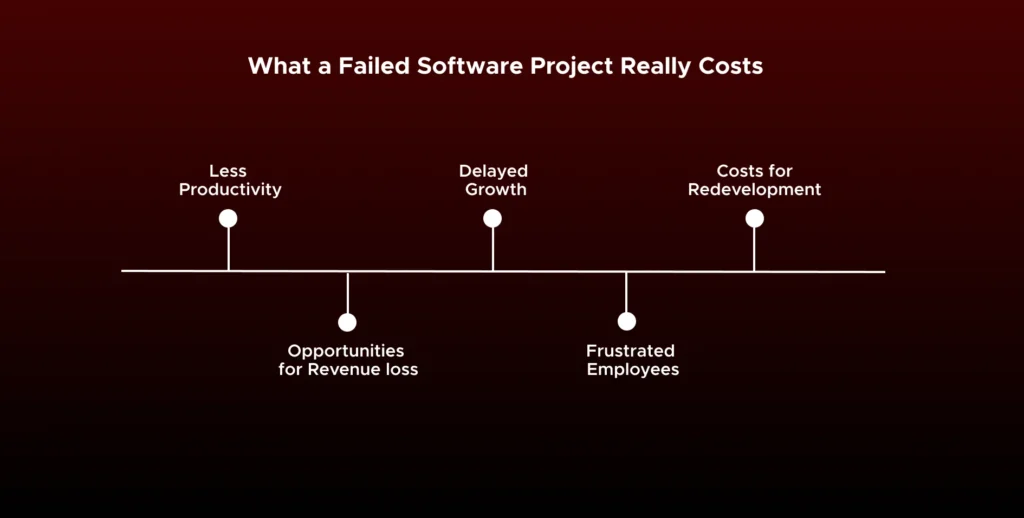
A majority of companies do not lose money in software due to a single error; they just are able to lose money through the compounding of delays and the need to rework.
- Less productivity: The team is working with manual methods even though the system remains inaccessible or not working.
- Delayed Growth: Business opportunities are not realized due to the scaling.
- Costs for redevelopment: Whole modules need to be rebuilt completely from scratch following an unsuccessful delivery.
- Opportunities for revenue loss: Bookings and sales pipelines or transactions are not properly captured.
- Frustrated Employees: The employees stop believing in the system and return to spreadsheets.
The latest research suggests that in the majority of projects that fail, the real expense is not a budget for development; it’s the cost of a system that is in place, but cannot be effectively utilized.

The 7 Biggest Reasons Software Projects Fail
The following are the seven major reasons for software project failure, along with software solutions as well.
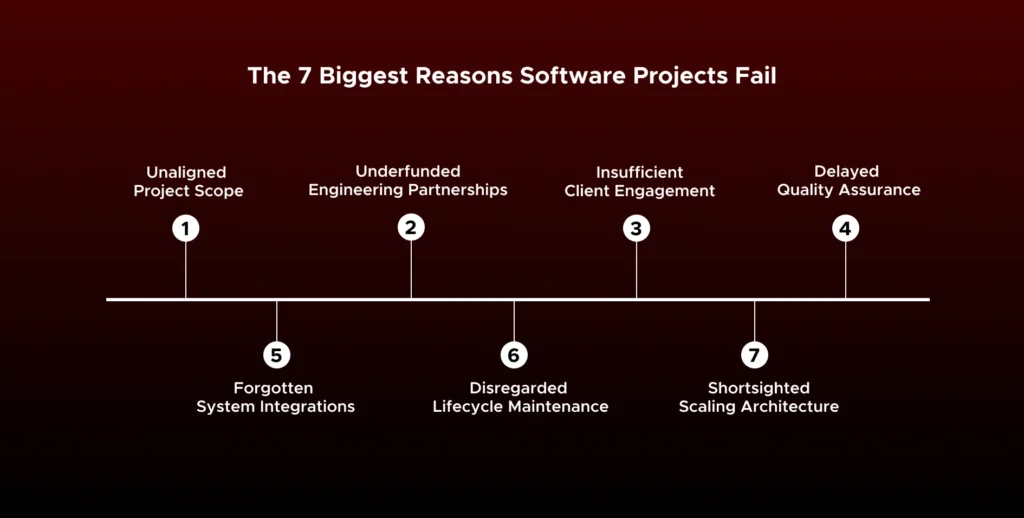
1. Unaligned Project Scope
Each software development project starts with documentation. Failure occurs when the written requirements do not meet the expectations of all parties. In real life, an individual stakeholder explains an idea verbally, then a developer creates the software based on what they have learned. After which, within two months, the initial demonstration reveals a significant gap in functionality. It is not a case of an issue of scope creep, but in the scope of the base.
Solution
Never type an ounce of code without having a written, specific functional specification for each page and interactive prototypes. Follow a systematic discovery process that lays out specific criteria for each component before the development process begins.
2. Underfunded Engineering Partnerships
When purchasing, teams view software as a commodity; they tend to compare the bottom-line numbers. If several firms offer the same amount for the same task, the lowest price does not always mean the same thing.
The price is usually low, which suggests a young team developing their portfolio heavily on rigid templates or a calculated low-ball plan that is designed to entice you into costly changes later. Professional engineering firms offer the top system architects a thorough review of code, automated testing pipelines, and extensive after-launch assistance. This is why you need to hire the right software development company.
Solution
Examine your development ideas by technical substance and not only the financial costs. Analyze their quality assurance systems, their source ownership clauses for code, and the deployment methods.
3. Insufficient Client Engagement
Software projects typically fail once project managers provide a short report, and then are entirely disengaged from running the day-to-day activities. If a development team functions in a gap for long periods of time, engineers have to come up with their own operating assumptions. This results in a system that works flawlessly in a technical sense, yet does not solve the business challenge.
Solution
Get the client in the loop as an internal position with the authority to decide. The role should be active in weekly sprint reviews. Unblock technical questions within 24 hours and constantly test new improvements. The agile approach is based on close, organized co-operation to keep the development process aligned with reality.
4. Delayed Quality Assurance
When testing is compressed to one rushed stage at the close of a dedicated timeframe, crucial issues arise. It then results in malfunctioning user flow slowdowns, a performance issue, and an immediate churn of users post-launch. Bugs caught in development are cheap, rapid fixes in minutes. Meanwhile, bugs caught post-launch are expensive patches, security vulnerabilities, and brand damage.
Solution
Adopt the continuous testing method. Do embed QA automation into every development part. Release software after it passes the strict unit tests that are automated and manual user Acceptance Testing (UAT) standards, and catches issues that are the cheapest to correct.
5. Forgotten System Integrations
A business transformation needs applications that seamlessly connect to the entire infrastructure of your enterprise. It is a mistake to develop core features of software initially and then treat APIs from external sources as an added feature, leading to data compatibility issues that are fundamental.
Solution
Plan the entire architecture of your integration on the first day. Note all API dependencies of third parties, along with authentication protocols, as well as data schemas, before constructing the core of your application. Create mappings that directly integrate with your system’s initial development stage.
6. Disregarded Lifecycle Maintenance
Software is an ongoing infrastructure and not a tangible product. When code becomes live, it is just the beginning of the cycle. Operating systems are updated, and third-party APIs are discarded, which causes security risks. In the absence of a structured technical on annual maintenance support system, the performance of software naturally decreases until the core functions cease to function completely.
Solution
Sign the formal agreement for maintenance of your software before the release. Establish specific service level agreements (SLAs) for critical issues, infrastructure updates, and monitoring security. Hire the top IT Infrastructure solution providers in Abu Dhabi to keep your app solid, reliable, and optimized for the long-term.
7. Shortsighted Scaling Architecture
A system designed just for transactions could be unable to keep up or experience serious database lockups when confronted by thousands of simultaneous users. Although cutting back on the normalization of databases, cache strategies, as well as cloud-based infrastructures, saves funds in the beginning, but create several technical debts that are costly to modify in the future.
Solution
Prioritize horizontal scaling during the design phase of your architectural plan. Create using microservices or containerized, modular structures that allow different parts of your system to grow easily under high loads. Or develop every platform using the future growth metrics built directly into the base code.

How Pixako UAE Helps Recover Failing Software Projects
The majority of systems that fail do not require rebuilding; they just need to be rebuilt in a correct way. Pixako UAE experts help with new and failed software projects in advanced ways to generate great outcomes.
The Problem
- Late deadlines.
- Missing or broken features.
- Insufficient user acceptance.
- Integration failures.
Why the Project Failed
- No clear expectations.
- A weak QA procedure.
- No integration planning.
- Incorrect architecture decisions.
What We Changed
- Rebuilt system architecture.
- Clarified functional scope.
- Introduced structured Q cycles.
- Redesigned layer of integration.
Results
- Stabilized system performance.
- Increased user acceptance.
- Business operations restored.
- Facilitated scalable growth.
Conclusion
In short, the success of software projects is not measured by the quality of code. It is determined through decision quality before the development process begins. Successful deployments do not mean to avoid custom technologies altogether; it’s about eliminating project-specific ambiguities through a clear and documented system.
Through implementing a specific exploration phase, insisting on constant quality control, and establishing your API integration strategy from the first day, you can eliminate those pitfalls that can weaken the development process. The software project failure rate can be transformed into a highly-performing digital asset that is specifically designed to improve your business process and streamline manual processes. Software often fails, but after following the mentioned solutions, you will get authority-level lead generation software.

Frequently Asked Questions
What is a software failure?
Software failures occur when a software system fails to function, either due to crashing, producing inaccurate outputs, or under the pressure of real-world use. Failure of software does not necessarily mean an application was never completed, as a lot of delivered software projects fail because they do not get the desired results or integration with other systems, or simply do not scale according to business expansion.
What are some software failures?
The most popular software project failure examples are:
- Healthcare.gov’s launch, which crashed in 2013.
- Knight Capital’s trading algorithm lost $440 million over 15 minutes in 2012.
- NHS patient record system that was abandoned in the wake of an PS10 million investment.
What are the reasons for software project failure?
The reasons for software project failures are changing software specifications, a lack of choice of developers in the absence of input from clients in the development procedure, a lack of quality assurance, the integration process with no pre-planned maintenance after launch strategy, or development that does not take into account scalability.
What are the challenges you face in software testing?
The main testing problems are testing environments that do not accurately represent the actual conditions in production. Also, the time pressures that lead to shortened testing cycles, unusual user behaviour, and a lack of an automated testing infrastructure to support testing regression. When it comes to web and mobile apps testing, cross-devices and across browsers is a further layer of complexity.