

Choosing the right tech stack for a UAE business app is not just about accepting developers’ suggestions. Instead, it involves selecting appropriate technologies based on the app’s goals, UAE regulations, user habits in the UAE, and future budget considerations.
UAE company owners are taken through the entire process of making decisions regarding their technology stack, starting from understanding its meaning to calculating the total cost of ownership in this book. If you own a company in Dubai or Abu Dhabi and need a custom app, the first thing that comes to your mind may be which technology stack to pick.
Most companies say yes to developers’ suggestions. This is a wrong approach, as it is important what technology stack to choose, since it affects budget, release date and developer selection. The company has to know what a stack is, how to select the right tech stack, and which questions to ask the developer. And if you are still deciding between custom software and pre-built software, start with these first.
This guide will discuss all factors to consider when choosing a tech stack and talk about Arabic language implementation, data regulation, and e-invoicing in this country.
What is a Technology Stack?
A tech stack is the whole set of tools you need to construct and operate your application. It is made up of 4 main components: database, hosting, front-end, and back-end technologies.
- Frontend: This is the part of the application the user sees and interacts with, e.g., React or Flutter.
- Back-end: server-side programming that takes care of authentication, orders, and payments. Some examples are Node.js and Laravel.
- Database: Where your data is stored, like PostgreSQL or MySQL.
- Host: Cloud servers (such as AWS or Azure) that host your app.
Other services utilised include payment gateways, SMS services, mapping services, and email services. These are also important since they raise the cost of your application. And need to integrate with the rest of your stack .
7 Steps To Build The Right App Stack In The UAE
Choose the right tech stack that matches your app type.
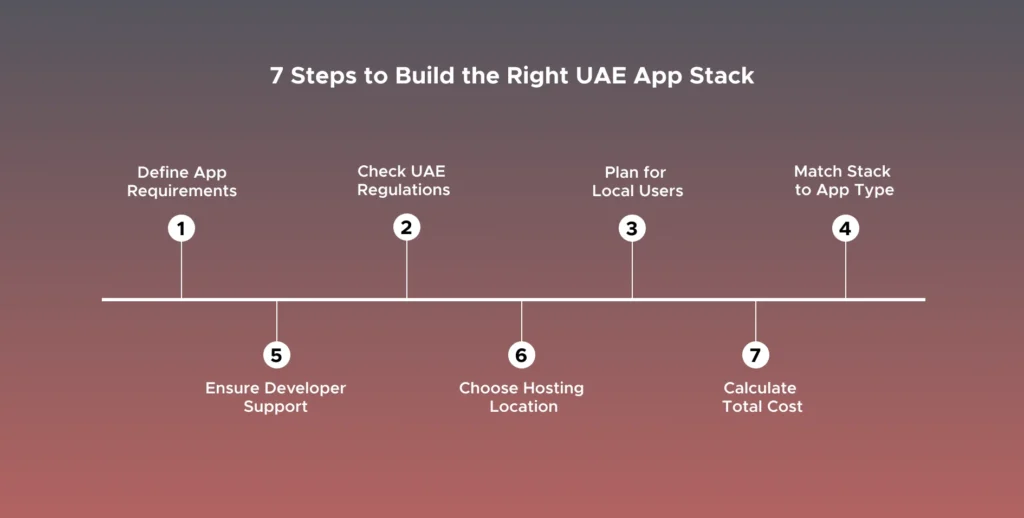
Step 1. Set the requirements for your app
Before you start talking about any technology, answer these questions on paper first; your answers should dictate the technology stack, not the other way around:
- Who will use the application: customer, staff, or both?
- Will it be a website, an app, or both?
- What functionality needs to be deployed right from the get-go, and what can wait?
- How many users do you anticipate having in year one?
- Will the system be integrated with other applications like as accounting, CRM or a payment gateway?
If not, ask your developer why they picked this technology stack in the first place, and then adapted your demands to it.
Step 2: Research UAE Regulations
UAE applications have many government regulations, including data privacy, health data, payment, and UAE Pass requirements, which differ by business. Always check with a lawyer or consultant to get the precise requirements.
Personal data: The UAE has federal data protection legislation (Federal Decree-Law No. 45 of 2021). If you are based in DIFC or ADGM, you need to comply with the data protection legislation specific to those free zones. Your tech stack must include access control, encryption, and the ability to remove users’ personal data.
Health data: Health applications face harsher rules. Federal legislation on health information bans the transmission of such information out of the UAE, with limited exceptions. Abu Dhabi has a standard on health care information security, and Dubai has health authority rules. If you are to utilise patient information, verify these first.
Payments: Use a licensed payment gateway for transactions and do not keep any card information on your own servers. Companies that do not comply will be penalised monthly. If your application produces invoices (e.g. an ordering, booking or marketplace application), ask your developer how your application will fit into the e-invoicing system. For further information, please visit the Federal Tax Authority website or contact your accountant.
If your customers are in the UAE, you may use UAE Pass for login.
Step 3. Creating Local Users
A stack for the UAE must handle Arabic and English, mobile-first design, local payment options, UAE phone login, and traffic surges in busy seasons. Most software requires both, including Arabic right-to-left layouts. Not all front-end frameworks make this simple. Test the Arabic screens early.
- Mobile-first: Most of the time your consumers will be utilising their phones to utilise your app. Even if the app is web-based, it has to work well on a mobile screen.
- Local payment options: Customers will want to be able to pay by card or use Apple Pay, but there may also be times when they wish to pay cash on delivery or use pay-later alternatives. Make sure your payment provider can accommodate all of them.
- Phone numbers and messages: Your customers log in using their UAE phone numbers and send messages using SMS and WhatsApp.
- Busy days: Increased user traffic during Ramadan, Dubai Shopping Festival, White Friday, and summer vacations. Ask your developer how the app will scale to additional users.
Need an app built for your business in the UAE?
See Our Software Development Services.
Step 4. Match the Stack to the Type of Your App
There is no single tech stack for web and mobile apps that works for everyone. The proper stack will be determined by what kind of app you are constructing. These are not rules; they are merely popular places to start.
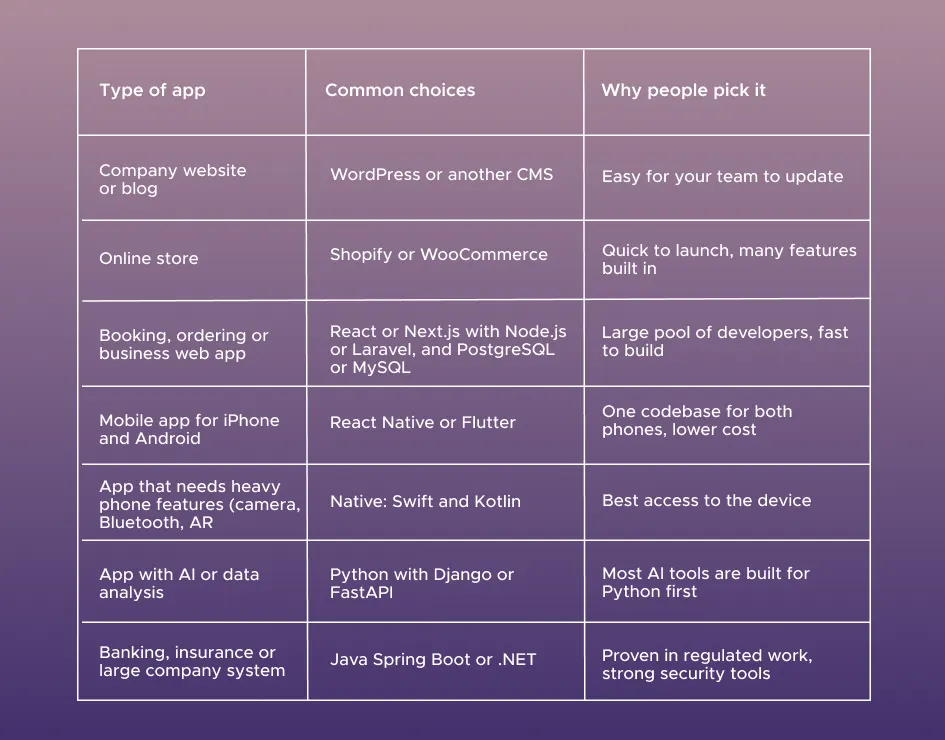
If all you need is a simple shop or website, a template-based platform is usually less expensive and quicker than bespoke development. Custom code: Useful when your procedure is distinctive and off-the-shelf products will not do it.
Step 5. Ask for Developer Help
The strength of a tech stack relies on the developer skill pool available to support it. So, choose a stack that has enough local developers to keep it alive long term. There are numerous development organisations in Dubai and Abu Dhabi, but skills are not fairly distributed. If you are still comparing partners, here are the steps involved in hiring the right software development firm.
Less popular stacks are more costly to maintain since there are fewer developers knowledgeable in less common stacks other than JavaScript, PHP, Python, Java, and .NET. Before you choose a stack, be sure of these things:
- You own the source code and code repositories.
- You have access to cloud, domain, and app store accounts.
- The code is nicely documented.
Many firms find themselves stranded at a vital time in their company, not able to control their code since these requirements were not set up from the outset.
Step 6. Choose a Hosting Location
Where you host your app matters for performance and regulatory compliance. Hosting in the UAE is generally the preferred option for local customers and regulated sectors. The UAE has data centres run by AWS, Microsoft Azure, and other large cloud providers.
But local firms like Core42 also provide their own cloud services. The list of areas is always updated, so you must verify the latest information before making a decision. In the UAE, hosting often improves performance for users located in the country and is sometimes enforced by industries such as healthcare or government.
Step 7. Calculate Total Cost
Ask for an AED cost prediction for 3 years before you sign on to the stack, since the total cost of ownership is significantly more than simply development. Ask for a quote with:
- Development and testing.
- Software license, if any.
- Bug fixes, updates, maintenance.
- Cloud infrastructure to grow with extra users.
- Test of integration and security of electronic invoicing.
- SMS texting and the cost of transactions. Maps and other premium services.
An inexpensive stack that is hard to maintain may cost you more in three years than a conventional, simple-to-support stack. All prices are in AED. Have your developer determine which of these charges will be monthly ongoing fees and which will be one-time costs.
Conclusion
In short, choosing the right tech stack is not just about code, but rather the foundation of your business. For you to successfully implement your vision in Dubai and Abu Dhabi, your project needs a fast-scaling technology stack that complies with data sovereignty requirements in the UAE and preserves your rights in terms of future ownership.
Whether it is developing a completely new product or getting an unbiased opinion on a developer’s proposal before you start working together, a technical consultation is definitely worth your time and money. Pixako UAE makes the transformation from your tough business goals into a secure and effective technological solution as easy as possible.
Got a Developer’s Quote and Not Sure About It?
How to decide what tech stack to use?
The technology stack also depends highly on the requirements of your project as well as your team’s current experience. You should consider the amount of time you will save in development using the framework you have chosen and the maintenance costs.
What is the best tech stack for app development?
The technology stack in mobile application development is entirely dependent on whether you are going to develop the app for Android and iOS platforms in a native way or cross-platform. It would be a mistake to say that there is a best technology stack. Among the most commonly used stacks are React Native and Flutter for cross-platform development and Swift and Kotlin for performance-based native app development.
How do I know the tech stack of a company?
To find out the tech stack of a company, you can use the information provided in job listings and see what technologies are listed as must-have for developers. You can also use some browser extensions such as BuiltWith and Wappalyzer that will show you the tech stack.
Which tech stack is in demand in 2026?
These are the top tech stacks to use in 2026: Full stack JavaScript frameworks like MERN (MongoDB, Express, React, Node.js); AI-based Next.js tech stacks like Python and LangChain; and vector database cloud-native serverless tech stacks.