

Struggling to get leads from a b2b social media PPC strategy? Fortunately, the 11 successful strategies will get you triple your current sales in 2026. Moreover, social media is not just for B2C brands anymore; you can use it too. However, only a small percentage will make lead creation and connection tactics that work well. To make successful plans, it’s important to know that a B2B social media strategy needs different approaches than an individual social media strategy.
People in your target audience are decision makers who look at LinkedIn during their morning coffee break, look for answers on YouTube, and interact with industry content across multiple platforms; these are people who want useful information instead of flashy ads. Remember, customers today want to know how knowledgeable you are about a product before they buy it. This trend gives B2B companies that spend in real social media strategies a huge chance. Pixako.ae is a social media strategy consulting agency that provides customized and innovative social media techniques to get business decision-makers interested.
Therefore, we have compiled this guide to provide you with a complete B2B social media strategy template to generate good leads.
What is B2B Social Media Strategy, and How is it Different?
B2B social media strategy or marketing is when you use different social networks to promote your goods or services directly to other businesses. In contrast, B2B social media marketing is very different from B2C marketing because its main goals are to build trust, show knowledge, and encourage longer sales processes. Specifically, the main differences are how the crowd acts and what they expect from the material.
Business-to-business buyers usually do a lot of study before making a choice, and they often involve more than one person in the process. When they are doing research, they like case studies and proof of ROI that teach them more than posts about living or fun. Because people take longer to make decisions, your sample social media strategy needs to include posts at different times of the buyer’s journey, from becoming aware of your business to finally thinking about buying it.
Our experts create data-driven campaigns that boost engagement and brand visibility.
Best Social Media Platforms for B2B Social Media Strategy
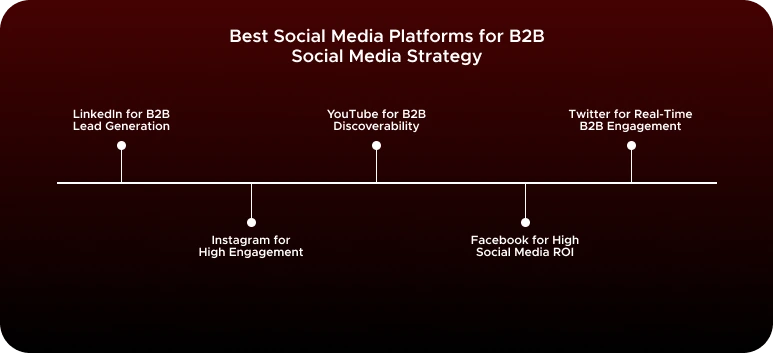
You need to choose the right social media supply chain industry for your marketing and engagement. The following are the top social media platforms that you can utilize for a business-to-business (B2B) social media strategy.
1. LinkedIn for B2B Lead Generation
LinkedIn is still the best place for business-to-business (B2B) social media marketing. It is a professional platform and a great place to share information about your company, insights into your industry, and thought leadership content. Moreover, key executives who use LinkedIn to build their personal brands often join industry groups and post content that solves problems in their companies. Similarly, LinkedIn has advanced targeting choices, so you can run paid ads to target particular b2b companies and customers.
2. Instagram for High Engagement
Instagram is usually thought of as a tool for businesses to connect with consumers, but it has a lot of surprising benefits for businesses in the tech, manufacturing, and artistic industries. For instance, you can use behind-the-scenes videos and visual stories on Instagram as great ways to promote your business’s culture and make your brand seem more real. Furthermore, you can also use Instagram stories to share changes in real time, IGTV to share longer teaching videos, or reels to quickly reach more people with tips or information about the industry.
3. YouTube for B2B Discoverability and Thought Leadership
YouTube is a social network and a search engine in one, which makes it a must-have for your B2B businesses to show you are a thought leader. In particular, the platform is a great place to host educational videos like product demos, customer reviews, industry analyses, and video explanations of complicated goods or services, so people do not have to read long descriptions. Likewise, its SEO benefits also make sure that your content shows up in Google search results.
4. Facebook for High Social Media ROI
Facebook is a great choice for your B2B company, especially for those who want to reach small to medium-sized businesses, because it has a powerful advertising platform and advanced tracking tools. Additionally, the group feature helps you build groups around industry topics or customer hobbies. As a result, you can reach similar prospects based on your current customer base with lookalike audiences and retargeting. As a result, this makes Facebook campaigns for generating leads very effective.
5. Twitter for Real-Time B2B Engagement
Twitter is the best place to communicate in real time, share stories about your business, and get great customer service. Thus, B2B companies can use Twitter to keep an eye on the industry in real time and to connect with prospects and customers. For instance, you can use hashtags to keep an eye on trends and spaces to have direct conversations with customers.
How to Pick the Right Channels for B2B Social Marketing
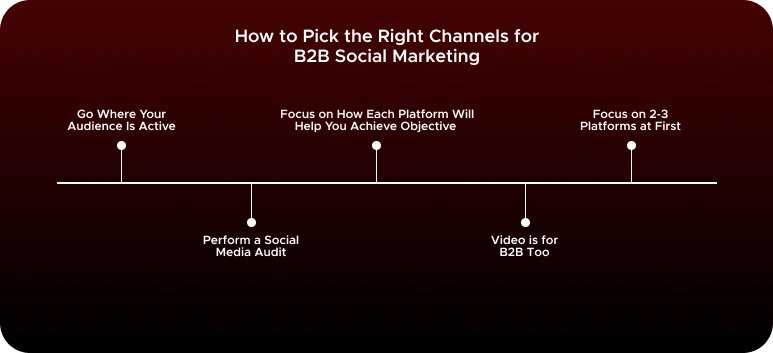
Ultimately, the proper use of platforms is essential to the success of your company’s social media marketing. Regardless, you must choose and use each app effectively.
1. Go Where Your Audience Is Active
First, identify where the people you want to reach spend their time online. For this, check out what current customers think about how they use social media, look at where your website’s visitors come from, and watch where your competitors succeed. Importantly, businesses tend to like different platforms for different purposes. Thus, target platforms that are related to your business and your reaching business, have, and do not just guess what platforms people like, prove it with data.
2. Perform a Social Media Audit
Secondly, check out which kinds of content get the most response, which posts do the best, and how the demographics of your followers match up with your ideal customer description. Likewise, you can easily find any weak spots in your social media engagement strategy plan. Likewise, you will be able to create better strategies. Finally, write down any trends you see in content that does well so you can figure out how they could be used on other platforms.
3. Focus on How Each Platform Will Help You Achieve Objectives
Then, match the tool you choose to your business goals. LinkedIn might be better for getting leads, while YouTube might be better for thought leadership. Additionally, Instagram might help people remember your name, and Twitter might make customer service better. Therefore, set clear goals for each platform you choose so you can correctly measure success by things like the number of leads generated, website traffic, or brand comments.
4. Video is for B2B Too
Video posts always do better than other types of social media posts, and business-to-business buyers really value video descriptions of complicated goods, services, or industry ideas. Consequently, you can make different kinds of videos, like product demos, customer reviews, behind-the-scenes footage, educational lessons, or communicate with executives. Ultimately, live video can help people connect with your brand and interact with it in real time.
5. Focus on 2-3 Platforms at First
Lastly, using two to three best social media platforms that work best for your audience and goals will help you make better content and get more people involved in the community. Once you do well on the main platforms, it will gradually become possible to move to new ones using previous strategies and techniques.
11 Strategies for Building a Full-Funnel Social Media Strategy
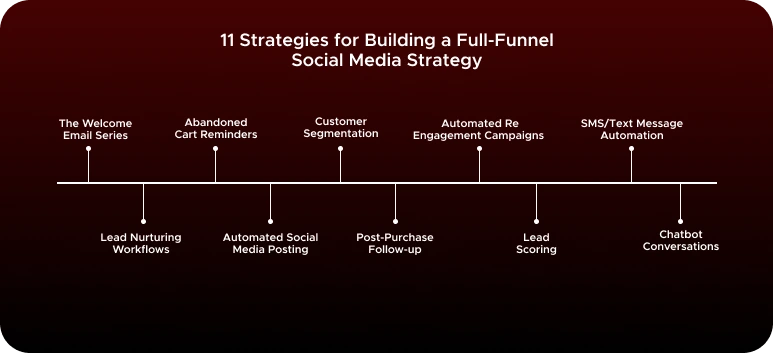
A whole funnel social media plan is a comprehensive method that helps you address every phase of your customers’ journey, from awareness, consideration, conversion, and retention. Through this funnel, you can successfully inform your clients about your company in order to meet their demands, build client loyalty, and boost sales.
1. Define Your B2B Objectives
Your social media plan will be based on clear goals in every way. Some common B2B social media goals are to get new leads, raise awareness of the business, show thought leadership, keep customers, and build communities. Significantly, different types of content, platforms, and ways to measure success are needed for each goal. For example, your blogs, articles, or tools on LinkedIn can be downloaded and used to generate leads, while visual content on multiple platforms could be used to raise brand recognition.
2. Identify Social Media Channels That Best Represent Your Business
Secondly, consider your brand’s attitude, your target audience, and the platform’s content skills before choosing the right ones for your business. Some software companies do better with training films on YouTube, while consulting firms might do better with thought leadership pieces on LinkedIn. Therefore, compare each platform’s content styles, audience profiles, and advertising options to your customers’ needs.
3. Generate the Right Content Ideas and Content with AI
Next, you can use AI tools to come up with ideas for content, write the first draft, and make sure it works best on different platforms. However, make sure to review and rewrite the content made by AI to fit your brand style and business knowledge. AI can quickly find topics that are popular in your industry, make versions of popular posts, or even make content plans. Moreover, this advanced technology is great at doing routine jobs so that your team can focus on creating strategies and building relationships.
4. Map Content Types to Funnel Stages
You should produce your content and identify relevant keywords by following the funnel steps.
- Top of Funnel (TOFU): TOFU content focuses on raising awareness and education. In this phase, you can share industry insights, trending topics, educational resources, and thought leadership content to resolve audience challenges without overtly selling your solutions. To get something new, you can include industry research, trend analyses, educational blog posts, infographics, or expert interviews that aim to establish your brand as an authoritative industry resource.
- Middle of Funnel (MOFU): MOFU content helps your prospects evaluate solutions and establish trust in you as an expert. In this phase, you can share case studies, detailed guides, webinar recordings, and customer success stories. Similarly, all the content will help you demonstrate your knowledge of specific challenges while subtly emphasizing the advantages of your solutions.
- Bottom of Funnel (BOFU): BOFU content supports final purchase decisions by providing customer testimonials, product demonstrations, ROI calculators, free trials, and consultation offers that address final objections and offer clear pathways towards engagement with your sales team. Additionally, make sure that there are strong calls-to-action that lead to conversion.
5. Create Video Content to Engage B2B Buyers
Notably, people are more likely to interact with video material than with text or picture-only posts, especially B2B buyers. In particular, they really like videos that explain complex ideas, represent goods, or communicate about positive customer experiences. This provides you with a chance to create short guiding videos for social media, longer webinar-style videos for thought leadership, and product sample videos as lead generation tools. On top of that, livestreaming allows you to make real connections and give people the chance to interact with you in real time.
6. Invest in Social Media Ad Campaigns
Next, organic reach keeps going down on most platforms, which makes paid advertising more and more important for B2B success. Specifically, social media advertising lets you target people with specific job titles, fields, company sizes, and habits very precisely. When you first start a campaign with a small budget, it is best to test your message and targeting to make sure they work before growing them. Furthermore, for optimal cost per lead/cost per acquisition results, focus on the platforms where your audience is most active.
7. Set Up Advanced Reporting
Similarly, your performance through reporting tools helps you reach your business goals instead of useless ones like the number of followers. An important B2B measure might be the number of leads generated or the amount of traffic that comes to a website from social media sites, as well as the rates of engagement and conversion. You can use Google Analytics to track the customer from their first interaction on your social media to the time they buy something. Ultimately, this information will help you improve your strategy and show stakeholders the return on their investment (ROI).
8. Communicate with Your Social Media Followers
Furthermore, social media is all about connecting with other people. So, use this platform wisely for answering comments quickly, joining conversations about your industry, and responding to content shared by users and prospects. Additionally, build relationships with influential people in your field by sharing their posts or leaving thoughtful comments on them, which can greatly increase your reputation and reach.
9. Use Personalized B2B Marketing Strategies
Likewise, personalization is more than just putting people’s names in posts. Instead, make your social media content that communicates about problems in your business, job roles, company sizes, or specific personas and funnel stages. Remember to use listening tools to learn more about your customers before writing or sharing posts that meet the specific needs and interests of each client. As a result, this will help you build better relationships with your clients and increase the chances of conversion.
10. Understand the Potential of Dark Social
Moreover, dark social is when people share private information through direct messages, emails, or messaging apps that make it hard to track. When making decisions, B2B buyers often share information secretly within their own companies. Therefore, include social sharing buttons, write quotable passages, and create tools that add value to internal communication to make your content easy to share. Additionally, monitor mentions of your brand and activity that could point to dark social sharing.
11. Incorporate User-Generated Content
Lastly, you should use user-generated content, including testimonials and reviews, to provide prospects with real social proof that makes your customer more likely to believe you. You can ask your previous clients to state their experiences, tag your brand in posts, or join hashtag campaigns. Afterwards, share customer success stories, testimonials, and case studies on all of your social media channels to do better than brand-created posts because these come from a real third party.
How Pixako. Com Transform Your Social Media Strategy
- Our expert uses social media growth strategies to take the guesswork out of B2b social media strategy by providing full branding services that help your company become a star in its field, and AI-powered insights and content creation that help you reach your target audiences. Our professional social media services provide you with stability and genuine connections across all channels to generate high-quality leads.
Moreover, we bring out the best in your brand through:
- Branding Services: We use consistent images and words that speak to your target audience to make an engaging brand experience.
- SEO/Digital Marketing Services: Our digital marketing experts get more people to read your content across all platforms with SEO services.
- Website Development: Our dedicated developers look into website development options to provide your users with an engaging and user-friendly experience.
- Mobile App Development: Besides social media strategy, we help you build your mobile app to get your customers more involved with your business by coming up with new app solutions.
Conclusion
In short, if you want to be successful at B2B social media strategy, you need to be patient, consistent, and give your target group real value. People and businesses expect real, non-advertising information that gives them important learning opportunities. They want to know how your goods are made and how your company works, besides connecting with the people who work for your brand. You should focus on telling interesting stories that connect with your audience and giving useful information that solves real business issues.
When you are communicating about your business beliefs and ways of doing things, be open and honest with the content strategy for social media, and make sure the information you give them is simple and easy to understand. B2B social media tactics that work best combine teaching value with strategic positioning to get the best results. Instead of just selling goods to customers, your social media managers should build groups around shared problems and hobbies where you can collaborate with people on social media to lead to sales calls, demos, or partnerships.
Lastly, posting, engaging, and creating value regularly builds trust, which is a key part of building high-value B2B connections. Social media could become one of your best ways to get new leads and grow your brand if you use the right tools or hire the best branding agency for your social media strategy.
We help you connect with decision-makers who matter and convert engagement into real opportunities.
Contact our experts now.
Frequently Asked Questions
What are b2b social media marketing trends in 2026?
The B2B social media marketing trends in 2026 focus on customization. Businesses use AI to create content that speaks to certain groups of people and build a strong community. People like to engage with short video content on websites, TikTok, and LinkedIn to get people involved.
What is the most popular social media in 2026?
Facebook is the most popular social media platform in 2026, with more than 1 billion users. Its wide reach and diverse user base make it essential for personal and business engagement. Even though there are new social media platforms, Facebook’s infrastructure and innovations keep it at the top for targeted advertising and community building due to its popularity.
How many seconds does it take to grab attention on social media?
Well, it depends on the business image, product quality, and marketing tactics. However, several marketers say it takes eight seconds to catch people’s attention on social media. So, make sure to add great photos and clear content to catch the attention of individuals.
What are the 7Ps of marketing?
7Ps are the most important things to think about when making marketing plans. These can help you look at and improve what you provide so that you are sure to fulfill client requirements. The 7Ps of marketing include:
- Product
- Price
- Place
- Promotion
- People
- Process
- Physical Evidence
What is 5 5 5 rule on social media?
The 5-5-5 rule on social media encourages brands to publish five times a week, respond to five comments every day, and spend five minutes on social listening. Sounds great? This method will boost community engagement and brand loyalty, helping you meet customer needs.